Account Abstraction via Apple Secure Enclave and Hardware Biometrics for Ethereum Wallets
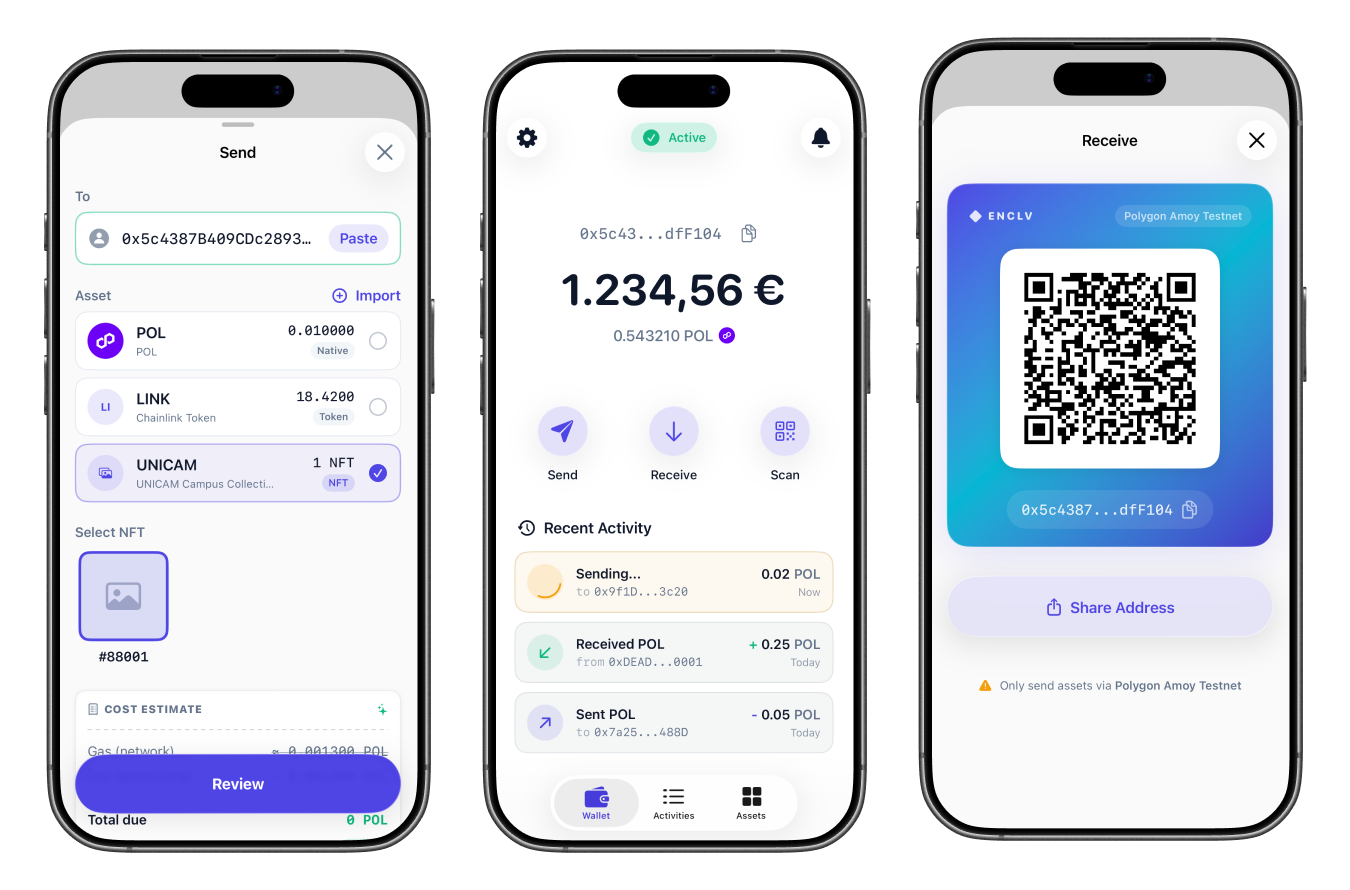
This Master's thesis in Computer Science investigates usable security (HCISec) in decentralized systems, exploring how hardware-backed cryptography and Account Abstraction (ERC-4337) can bridge the gap between strong security guarantees and seamless user experience. The Enclv iOS application was developed as the practical proof-of-concept prototype for this research, demonstrating a seed-phrase-free Ethereum wallet where private keys are generated and stored inside the Apple Secure Enclave, transactions are authorized via Face ID, and account recovery is built on Passkeys combined with zero-knowledge hardware attestation.
Motivation
A persistent tension in wallet design.
The mnemonic seed phrase remains one of the principal barriers to broad adoption of self-custodial Ethereum wallets. A sequence of 12 to 24 randomly drawn words constitutes the sole credential for an account: if lost, the wallet is permanently inaccessible; if exposed, all associated assets can be transferred without recourse. There is no credential-reset mechanism and no custodial fallback.
Existing designs navigate a three-way tension between the properties below. Addressing any two tends to compromise the third, and no prior work resolves all three simultaneously within a non-custodial model.
Approach
Composing Apple and Ethereum primitives.
The thesis proposes eliminating the seed phrase by composing three complementary primitives: hardware-backed key storage, programmable smart accounts, and an efficient on-chain signature verification precompile, each addressing a distinct side of the trilemma.
The Apple Secure Enclave Processor (SEP) is a dedicated cryptographic co-processor physically isolated from the application CPU. Key generation and all signing operations occur exclusively within the SEP; the private key material is never exposed to the operating system or application layer. User authorisation is delegated to Face ID or Touch ID, removing the need for passwords or mnemonic transcription.
Addresses security and usability jointly.
Rather than a standard externally-owned account (EOA) bound to a single key, each
Enclv wallet is implemented as a smart account. A Validator module
verifies secp256r1 signatures from the Secure Enclave,
an Executor module handles intent-based transaction dispatch, and
Hook modules enforce policies such as spending rate limits and
recovery timelocks. The modular design allows individual components to be replaced
without altering the wallet's on-chain address or identity.
The Secure Enclave operates over the secp256r1 (P-256) curve, whereas Ethereum's native ECDSA implementation uses secp256k1. Pure-Solidity P-256 verification has historically required around 330,000 gas per operation. The RIP-7212 precompile, deployed on Polygon and several other L2 networks, reduces this to approximately 3,450 gas, making hardware-native signatures economically feasible within a realistic fee budget.
Reduces P-256 verification cost by roughly 99%.Technical Architecture
Two design contributions beyond standard implementations.
The following components represent the primary research contributions of the thesis, distinguishing Enclv from a straightforward smart account wallet implementation.
Apple's App Attest framework allows a device to demonstrate that a given key pair was generated inside a genuine Secure Enclave. However, the resulting attestation certificate contains identifiable metadata: device model, AAGUID, and a receipt, that cannot be published on-chain without privacy implications. To retain the cryptographic guarantee while discarding the identifying fields, Enclv wraps the attestation verification inside a ZK-SNARK circuit implemented with Circom and snarkjs. The on-chain validator receives only the proof, not the raw certificate.
App Attest · snarkjs · Circom · Groth16 proof system
Device loss must not result in permanent account inaccessibility, yet a recovery mechanism cannot introduce an exploitable backdoor. The proposed scheme enforces a 48-hour timelock before any recovery transaction is executed, followed by a 7-day quarantine window during which the original key holder can submit a cancellation. Passkeys synchronised via iCloud Keychain serve as an out-of-band second factor, enabling access restoration on a new device without seed phrase involvement.
Passkeys · WebAuthn · ERC-7579 Hook modules · 48h timelock · 7d quarantine
Technology Stack
A three-layer monorepo architecture.
The implementation is structured as a monorepo comprising three layers: a native iOS application, a server-side backend responsible for ZK attestation verification and UserOperation relaying, and a set of on-chain Solidity smart contracts.